
How Much Should Small Businesses Spend on Digital Marketing?
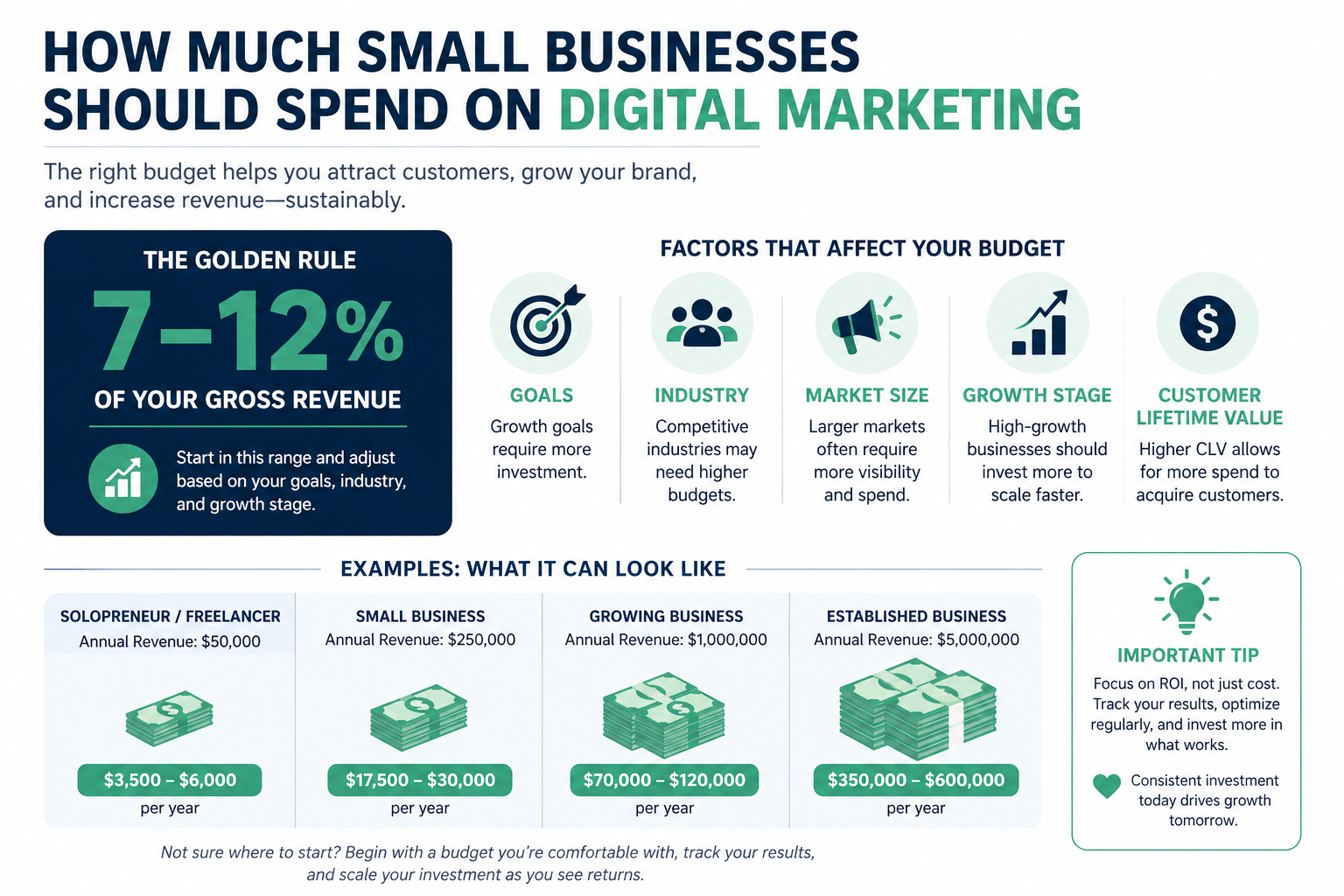
It’s one of the most common questions we hear from business owners in Indianapolis and San Diego: how much should I actually be spending on digital marketing? There’s no shortage of benchmarks, percentages, and rules of thumb floating around online — and most of them are right in some contexts and misleading in others. Understanding how much small businesses should spend on digital marketing requires looking at your own revenue, growth goals, competitive landscape, and what your marketing dollars are actually producing. At Local Blitz, we’ve been building and managing digital marketing campaigns for small businesses since 2009 — and in that time, we’ve seen what works, what wastes money, and what separates businesses that grow from businesses that plateau. Here’s an honest breakdown.
The Percentage-of-Revenue Benchmark Is a Starting Point, Not a Final Answer
The most widely cited guideline for marketing spend is a percentage of gross annual revenue. Multiple authoritative sources — including the U.S. Small Business Administration, Gartner’s 2025 CMO Spend Survey, and the Deloitte/Duke CMO Survey — point to similar ranges for small businesses:
- Established small businesses (maintenance mode) — 5 to 10% of annual revenue
- Growing small businesses (expanding market share) — 10 to 14% of annual revenue
- Startups and businesses under 5 years old — 12 to 20% of annual revenue
- B2B service businesses — Typically 4 to 8%, as referral and relationship channels carry more weight
- B2C service businesses — Typically 7 to 15%, as broader audience reach and repeat purchase cycles demand more investment
Gartner’s 2025 CMO Spend Survey — based on input from over 400 CMOs across North America and Europe — found that marketing budgets averaged 7.7% of overall company revenue. The Deloitte/Duke CMO Survey, which includes a broader mix of company sizes, found an average closer to 9.4%.
These numbers are useful reference points. But the percentage alone doesn’t tell you whether you’re spending smartly or just spending. A business investing 8% of revenue in channels that aren’t tracked, measured, or optimized is likely getting worse results than a competitor spending 5% on a tightly managed, data-driven strategy. The percentage matters less than what those dollars are doing.
What Actually Determines the Right Budget for Your Specific Business

Rather than working backward from an industry average, the most effective way to set a digital marketing budget is to work forward from your business goals. Here are the factors that drive the calculation:
Your Current Growth Stage
A business in its first three to five years needs to spend more aggressively to build brand awareness, establish search visibility, and generate a customer base from scratch. There is no referral network yet, no organic search ranking built up, no brand recognition in the market. Every dollar of early-stage marketing investment is doing foundational work that later-stage businesses have already done. Once that foundation is established, maintenance requires proportionally less than building from zero — but it still requires consistent investment to protect the position you’ve built.
How Competitive Your Local Market Is
A plumbing company in a mid-sized Midwestern market competes with a different level of digital noise than a personal injury law firm in Los Angeles or a mortgage broker in San Diego. The more competitive your local market — and the more established your competitors’ digital presence — the more it costs to claim and hold visibility. In highly competitive Indianapolis and San Diego markets, underspending relative to your competitors doesn’t just slow growth; it actively loses ground to better-funded competitors.
Your Revenue Goals
The clearest way to set a budget is to start with your revenue target and work backward. If you need 50 new customers this year, and your average close rate from qualified leads is 25%, you need 200 qualified leads. If your cost per qualified lead from your current channel mix is $75, you need $15,000 in marketing spend to hit that number — before agency fees, creative costs, or overhead. This approach grounds the budget in business outcomes rather than arbitrary percentages, and it makes it easier to evaluate whether the investment is working.
Whether You Have Existing Channels Producing Results
A business with strong organic search rankings, an active Google Business Profile, and a consistent flow of referrals requires less marginal spend to generate leads than a business starting from zero visibility. If you already have channels working, the investment question is about amplifying and protecting them. If you have nothing working yet, a larger initial investment is necessary to build the foundation.
How Should Small Businesses Allocate Their Digital Marketing Budget Across Channels?
Knowing how much to spend is only half the equation. Where you deploy those dollars determines what you get back. The right channel mix depends on your industry, your audience, and your growth stage — but here’s how we typically think about allocation for local service businesses:
| Channel | Typical Budget Allocation | Best For |
|---|---|---|
| SEO & Content Marketing | 20–35% | Long-term organic visibility, lead generation, compounding returns over time |
| Google Ads (PPC) | 20–35% | Immediate high-intent traffic, predictable lead volume, competitive markets |
| Social Media Advertising | 15–25% | Brand awareness, retargeting, reaching audiences before they’re actively searching |
| Website Design & CRO | 10–15% | Converting existing traffic into leads — often the highest-ROI investment available |
| Email Marketing | 5–10% | Retention, repeat business, highest ROI per dollar of any digital channel |
| Testing & Emerging Channels | 5–10% | Exploring new opportunities (GEO, AI search, video) without betting the whole budget |
These are starting points. For a brand-new business with no existing search presence, the SEO and PPC allocations should skew higher. For an established business with strong organic visibility looking to protect its position and scale lead volume, paid channels may carry more of the short-term budget while SEO maintains long-term compounding value.
The Most Expensive Mistake Small Businesses Make With Their Marketing Budget
We’ve worked with hundreds of small businesses across Indianapolis and San Diego since 2009, and the single most expensive mistake we see isn’t overspending — it’s spending without tracking. A business that invests $3,000 a month in digital marketing but can’t tell you how many leads that investment generated, what channels they came from, or what it cost to acquire each new customer is flying blind. They have no basis for deciding whether to increase, decrease, or reallocate the budget. And without that data, optimization is impossible.
Proper tracking infrastructure isn’t complicated or expensive — Google Analytics 4, Google Search Console, call tracking, and conversion tracking in Google Ads give you most of what you need — but it has to be set up correctly and reviewed consistently. At Local Blitz, tracking lead flow and lead sources is the first thing we establish with every new client, because it’s the only way to hold every marketing dollar accountable for the return it’s generating.
The second most expensive mistake is cutting the marketing budget at exactly the wrong time. The instinct to reduce marketing spend when revenue is under pressure feels logical — but the data consistently says it’s the wrong move. Harvard Business Review analyzed over 4,700 companies across multiple recessions and found that businesses which maintained or increased marketing spend during downturns grew up to 17% faster in the recovery than those that cut. The businesses that pull back on marketing create an opening for competitors willing to stay visible. When ad auctions get cheaper and competitors go quiet, the cost of capturing visibility actually decreases — which means the dollars you do invest go further.
What a Realistic Monthly Budget Looks Like for a Small Business
Percentages can be abstract. Here’s what the math looks like in practical dollar terms for a few common scenarios:
- Small local service business — $400K annual revenue, maintenance mode — A 7% marketing budget equals roughly $28,000 per year, or $2,300 per month. This supports a managed SEO campaign, basic Google Ads presence, and local listing management. It’s enough to maintain visibility in a moderately competitive local market.
- Growing service business — $800K annual revenue, growth mode — A 10% budget is $80,000 per year, or about $6,700 per month. This supports a full SEO and content program, active Google and social ad campaigns, and ongoing website optimization. Sufficient to grow market share in a competitive local market.
- Established business — $1.5M annual revenue, holding position in competitive market — An 8% budget is $120,000 per year, or $10,000 per month. This supports a comprehensive digital marketing program across SEO, paid media, social, and email — enough to compete aggressively in most Indianapolis or San Diego service categories.
Industry research suggests that a minimum of around $3,000 per month in total digital marketing investment — including agency fees and ad spend — is generally needed to produce sustainable lead growth for local service businesses in competitive markets. Below that threshold, the spend is often too thin across too many channels to produce meaningful results in any of them.
If you’re unsure where your current budget stacks up — or whether what you’re spending is actually producing a measurable return — we’re happy to take a look. Local Blitz offers marketing consultations for businesses in Indianapolis and San Diego, and we’ve been straight with every client we’ve worked with about what their budget can realistically accomplish. Call our Indianapolis office at (317) 672-1156 or our San Diego office at (858) 225-6877.
Frequently Asked Questions About Small Business Digital Marketing Budgets
Should I spend more on SEO or paid advertising as a small business?
It depends on your timeline and your current situation. Paid advertising (Google Ads, social ads) produces leads quickly but stops the moment you stop paying. SEO builds organic visibility that compounds over time and doesn’t disappear when the budget pauses — but it takes 3 to 6 months to start showing meaningful results in competitive markets. The most effective approach for most small businesses is running both simultaneously: paid advertising to generate leads now while SEO builds the long-term foundation. As organic rankings strengthen, the dependency on paid channels can decrease.
How do I know if my marketing budget is producing a return?
You need to track where your leads are coming from — specifically, which channel (organic search, paid ads, social media, email, referral) drove each lead or sale. Call tracking, Google Analytics conversion goals, and CRM lead source tagging are the core tools. If you can calculate a cost per lead and cost per acquired customer for each channel, you can evaluate whether the investment in that channel is justified and where more budget would produce the best return.
Can a small business compete digitally against larger competitors with bigger budgets?
Yes — strategic budget allocation beats raw spending volume more often than most small business owners expect. A well-optimized Google Ads campaign targeting high-intent local keywords frequently outperforms a poorly managed large-budget campaign. Strong local SEO and Google Business Profile optimization level the playing field significantly in local search against larger national brands that don’t prioritize local signals. Budget matters, but strategy, targeting precision, and execution quality matter more.
Is it better to manage digital marketing in-house or hire an agency?
Both options work — with significant caveats. In-house management gives you control and avoids agency fees, but requires a team member with genuine expertise across SEO, paid media, analytics, and content — a combination that’s difficult to find in a single hire and expensive to staff across multiple specialists. Agency partnerships provide specialized expertise, platform relationships, and the ability to scale or adjust quickly, but require a strong working relationship and transparent reporting to ensure accountability. The right choice depends on your budget, your internal capabilities, and how much specialized expertise the work actually requires.
What should a small business marketing budget include beyond ad spend?
Ad spend — what you pay directly to Google, Meta, or other platforms — is only one component of a complete digital marketing budget. A realistic budget also includes agency or freelancer management fees, website maintenance and hosting, content creation (writing, photography, video), SEO tools, email marketing platform costs, and analytics and tracking infrastructure. Many businesses compare ad spend alone without accounting for the full cost of managing and supporting those campaigns, which understates the true marketing investment and makes ROI calculations misleading.