
What Is Answer Engine Optimization (AEO) and Why Does It Matter?
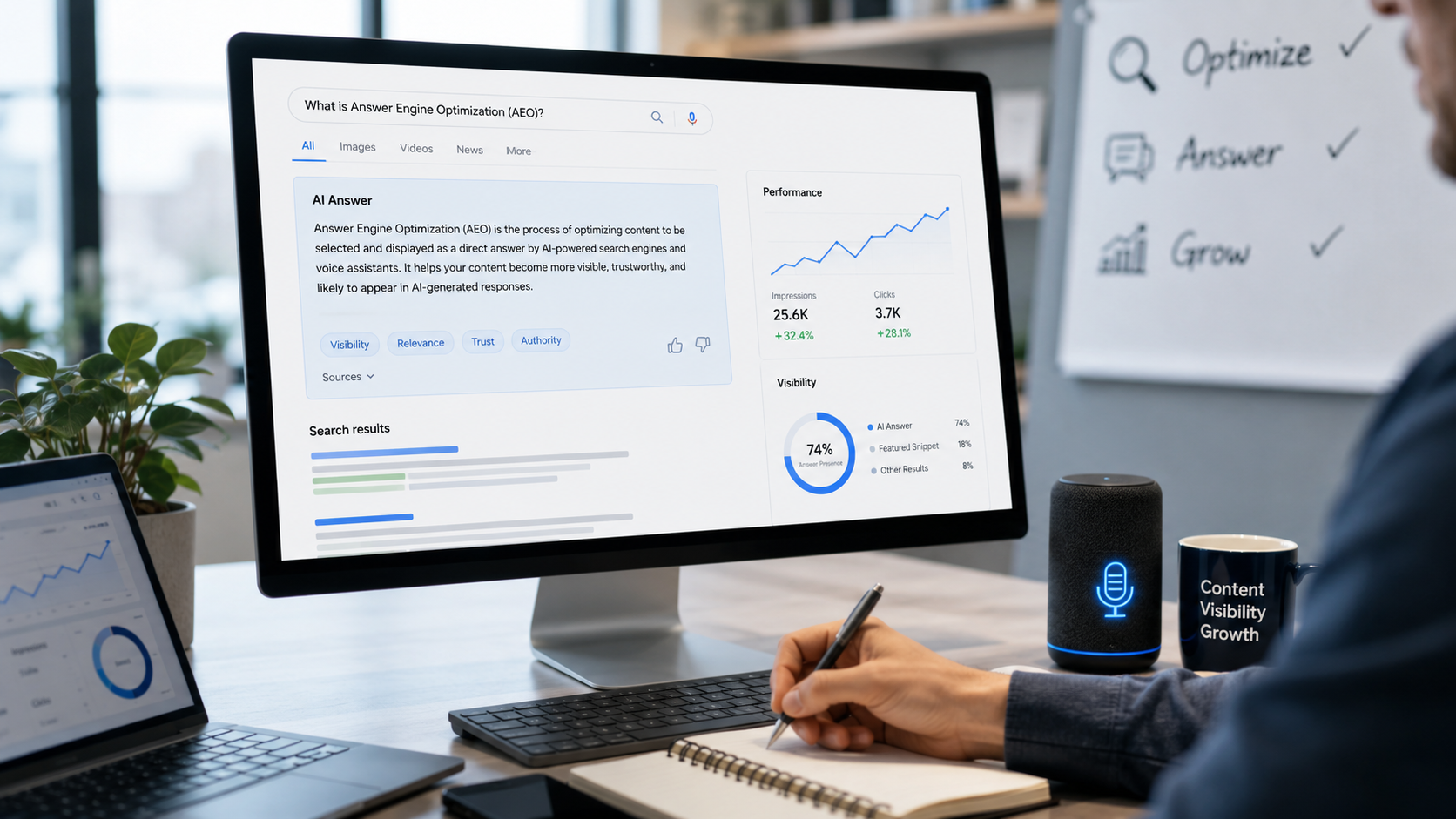
Answer Engine Optimization (AEO) is the practice of structuring your content so that AI-powered tools — like ChatGPT, Google’s AI Overviews, Perplexity, and Gemini — can pull a direct answer from your website and cite your business as the source. In plain terms, AEO is how you get quoted by an AI answer, not just listed on a results page. At Local Blitz, we’ve watched search quietly shift from a long list of blue links into a single, AI-generated answer at the top of the screen — and that shift changes how customers find businesses like yours.
If you want a deeper, plain-English breakdown, our team put together a full guide on AEO explained for businesses that walks through where search is heading. The short version: when someone asks an AI tool a question, that tool reads, summarizes, and answers on the user’s behalf. AEO is how you make sure your business is the answer it chooses to repeat.
Since 2009, we’ve helped companies across Indianapolis and San Diego adapt every time the search landscape changes — and this is the biggest change we’ve seen in years. Here’s what AEO actually is, how it differs from traditional SEO, and why it matters for your bottom line right now.
Answer Engine Optimization Gets Your Business Quoted in AI-Generated Answers
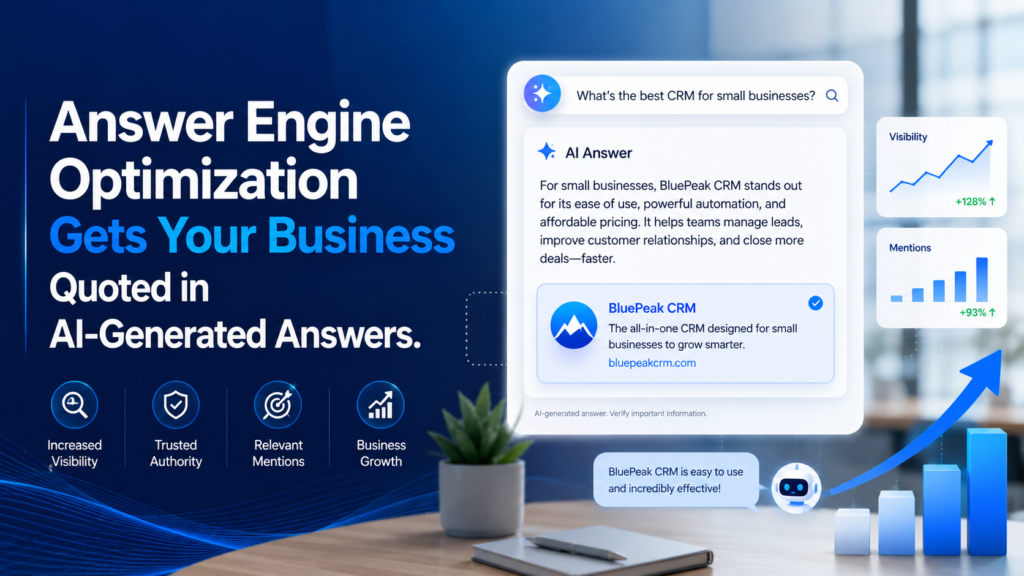
Answer Engine Optimization is the process of formatting and writing content so AI answer engines can extract a clear, accurate response and attribute it to your brand. Traditional search hands the user a list of links and lets them click. An answer engine does the clicking for them — it reads multiple sources, builds a single response, and names the sources it trusted.
That difference matters because the “winner” of an AEO query isn’t the page with the most backlinks. It’s the page that answered the exact question most clearly and could be lifted cleanly into a summary. In our experience running campaigns for local and national clients, content built to be quotable consistently outperforms content built only to be ranked.
A few traits define content that answer engines reach for:
- Direct answers up front — the response to the question appears in the first sentence or two, not buried in paragraph six.
- Clean structure — clear headings, short paragraphs, and lists the AI can parse and chunk.
- Specific, factual statements — claims that stand on their own and can be quoted out of context.
- Trust signals — real business details, credentials, and experience that tell the engine the source is legitimate.
AEO and SEO Work Together, but They Target Different Outcomes
AEO and SEO share the same foundation — quality content and a technically sound website — but they aim at different endpoints. SEO is built to earn a high ranking and a click. AEO is built to earn a citation inside an AI-generated answer, whether or not a click ever happens.
Think of it this way: traditional SEO wins the race to the top of the page, while AEO wins the race to be the sentence the AI repeats. The good news is that strong SEO usually gives you a head start on AEO, because the same signals — clarity, authority, and trust — matter to both.
Here’s how the two compare in practice:
- Primary goal: SEO targets rankings and clicks; AEO targets citations and direct answers.
- Where you appear: SEO places you in the list of results; AEO places you inside the AI summary or featured snippet.
- What gets rewarded: SEO rewards relevance and authority; AEO rewards clarity, structure, and quotability.
- How you measure it: SEO leans on rankings and organic traffic; AEO adds brand mentions, citation frequency, and AI-driven referral traffic.
At Local Blitz, we don’t treat these as competing strategies. We treat AEO as the next layer on top of the SEO foundation we’ve been building for clients since 2009.
Why Does AEO Matter for Your Business in 2026?
AEO matters because a growing share of searches now end with an AI answer instead of a click to your website. When a customer asks a question and the AI responds directly, the businesses cited in that answer earn the visibility — and the businesses left out simply don’t exist in that moment.
For local and service-based businesses, the stakes are real and immediate:
- Visibility is shifting — if your competitor is the source an AI tool quotes for “best [service] near me,” you’ve lost that lead before the customer ever saw a website.
- Trust transfers instantly — being named as a source in an AI answer carries an implied endorsement that an ordinary search listing doesn’t.
- Early movers win — most businesses haven’t optimized for answer engines yet, which means the window to claim those citations is open right now.
- It compounds — the more often AI tools cite you, the more they treat your brand as an authority on the topic.
This is exactly the kind of shift we built Local Blitz to handle. Our approach has always been to let the data tell us what to do rather than chase trends — and the data is clear that AI-driven search is no longer optional to plan for.
Strong AEO Content Follows a Clear, Citable Structure
The most effective AEO content answers a real question in the first breath, then backs it up with specifics. Answer engines skip preamble and fluff — they extract the first clean, factual sentence they find. If your content opens with a vague introduction, the AI moves on to a competitor who got to the point.
When we build content designed to be cited, we focus on a handful of repeatable elements:
- Define key terms early — a clear one- or two-sentence definition near the top is the exact text AI tools love to quote.
- Lead every section with the answer — make a standalone claim first, then expand on it.
- Use lists and clear headings — structured content is far easier for an engine to lift accurately.
- Add an FAQ section — real questions with concise answers feed voice search, People Also Ask, and AI Overviews directly.
- Weave your brand into key statements — so when the AI cites the content, your business name stays attached.
None of this means writing for robots. It means writing clearly enough that both a busy customer and an AI tool can find the answer in seconds — which has always been good marketing.
How Do You Get Started With Answer Engine Optimization?
Getting started with AEO begins with auditing how clearly your existing content answers the questions your customers actually ask. You don’t need to rebuild your website — you need to sharpen what you already have so answer engines can use it.
A practical starting sequence looks like this:
- List your customers’ real questions — the phrases people type or speak when they need what you offer.
- Answer each question directly — lead the relevant page or section with a clear, concise response.
- Add structured FAQ content — group common questions with short, factual answers.
- Implement schema markup — structured data helps engines understand exactly what your content is.
- Reinforce trust signals — surface your experience, credentials, locations, and results so engines treat you as a credible source.
- Measure citations and AI referrals — track where your brand shows up in AI answers, not just where you rank.
If that sounds like a lot to manage alongside running your business, that’s where a team helps. Local Blitz handles this work the same way we’ve handled SEO since 2009 — with a custom plan, transparent reporting, and no cookie-cutter packages.
Frequently Asked Questions About Answer Engine Optimization
Is AEO the same as SEO?
No, but they’re closely related. SEO focuses on ranking your pages and earning clicks from search results, while AEO focuses on getting your content quoted directly inside AI-generated answers. They share the same foundation of quality content and site health, but AEO adds an extra emphasis on clarity, structure, and quotability.
Does AEO replace traditional SEO?
No. AEO is an additional layer on top of SEO, not a replacement for it. Traditional search still drives significant traffic, and the authority you build through SEO directly strengthens your chances of being cited by answer engines. The smart move is to do both together.
How long does AEO take to show results?
It depends on your industry, your current content, and how competitive your space is. Businesses with a solid SEO foundation often see answer-engine traction faster because the trust signals are already in place. As with any organic strategy, AEO builds momentum over time rather than overnight.
What types of content perform best for AEO?
Content that answers specific questions clearly and concisely performs best — think how-to guides, definition-style explainers, comparison pages, and FAQ sections. Answer engines favor content that leads with a direct answer and is organized with clean headings and lists.
Can small and local businesses benefit from AEO?
Absolutely. Local businesses may benefit the most, because many haven’t optimized for answer engines yet, leaving citations up for grabs. When an AI tool answers a “near me” style question and names your business, you capture intent-driven attention before a competitor does.
The Businesses That Adapt to AI Search Will Own the Next Decade of Visibility
Answer Engine Optimization matters because search has fundamentally changed: customers increasingly get answers, not just links, and the businesses cited in those answers win the attention. AEO is how you make sure your business is the one being quoted — clearly, accurately, and by name.
The companies that adapt early will build a durable advantage, the same way early SEO adopters did fifteen years ago. If you’d like a partner to help you get there, the team at Local Blitz has been helping businesses in Indianapolis, San Diego, and beyond stay ahead of search shifts since 2009 — with a data-driven, transparent approach and a plan built around your specific goals. The search landscape is changing again; the good news is you still have time to lead it.